On 18 September 1793, George Washington helped lay the cornerstone of the United States Capitol in a Masonic ceremony. Eighteen years earlier, Prince Hall and fourteen other Black men had entered a military lodge in Boston, beginning a tradition that white American grand lodges would spend generations refusing to recognize. Both events belong near the beginning of an American Masonic history. One became a national civic image. The other exposed the distance between fraternity’s promises and the society in which it operated.
The institution that spread across the United States was never governed by a single American grand master. It grew through provincial charters, independent state grand lodges, military lodges, immigrant communities, and rival jurisdictions. Its buildings ranged from rented rooms above taverns to urban temples with auditoriums, libraries, and richly decorated ceremonial halls. Its members included presidents and printers, railway employees and merchants, abolitionists and slaveholders. Women built extensive affiliated organizations and, from the beginning of the twentieth century, worked as initiated Masons in mixed lodges.

Colonial lodges and Atlantic connections
Freemasonry arrived through the same ports, shipping routes, military movements, and print networks that connected British North America with the Caribbean and Europe. A lodge needed people who knew the ceremonies, a room in which to meet, money for its expenses, and some accepted basis for exercising authority. Those requirements could be assembled before a later grand lodge had settled its own jurisdictional boundaries. Claims to be the first American lodge therefore turn on what is being counted: a reported meeting, a surviving account book, a provincial appointment, or an uninterrupted charter.
Philadelphia’s St. John’s Lodge was active by the early 1730s. Benjamin Franklin joined the fraternity in 1731 and became a provincial grand master in Pennsylvania in 1734. That year he printed an American edition of James Anderson’s Constitutions of the Free-Masons. A London text could now circulate from a Philadelphia printing office. Its historical legends, regulations, and charges helped give scattered lodges a common vocabulary, even where actual practice differed.16

In Boston, Henry Price received an English provincial appointment in 1733. The organization associated with him met at the Bunch of Grapes tavern. Taverns offered privacy, food, drink, and rooms large enough for business and ceremony; their use was ordinary eighteenth-century associational practice. A lodge brought together men who might otherwise meet as customers, creditors, political opponents, or members of different congregations. Officers, minutes, subscriptions, and ballots gave that sociability a durable structure.1
The colonies did not receive one uniform system. English, Scottish, and Irish warrants coexisted. After the formation of the rival English “Antients” grand lodge in 1751, the division between Antients and Moderns also crossed the Atlantic. The terms referred to competing claims about ritual and authority, not simply to old and new lodges. In some colonies parallel provincial organizations developed; in others, lodges worked under authorities far from their eventual state capitals.
Revolution, Washington, and public ceremony
American independence broke imperial political authority without immediately erasing Masonic relationships. Lodges contained supporters of the Crown as well as supporters of independence. British military units carried warrants; Continental soldiers formed and attended military lodges. Fraternal language could make a stranger recognizable across political lines, but it did not keep Masons from fighting one another. The Revolution was neither directed by an American Masonic headquarters nor fought by a fraternity united on one side.
Washington’s membership is unusually well documented. Fredericksburg Lodge initiated him on 4 November 1752, when he was twenty. He became a Fellowcraft on 3 March 1753 and a Master Mason on 4 August. His surviving associations with lodges continued during the war and after his presidency. In June 1779 he attended a St. John’s observance associated with American Union Lodge, a military lodge with Connecticut origins.2
Paul Revere offers another view of the connection between craft, business, and revolutionary politics. The silversmith belonged to Boston’s St. Andrew’s Lodge and later became Grand Master of Massachusetts. He belonged to overlapping circles of work, patriot organization, and fraternity. Revere’s workshop, lodge, and political associations connected him with different parts of Boston society.

Washington’s place in Masonic public ceremony grew after the war. Alexandria’s lodge made him an honorary member in 1784 and named him charter Master when it transferred from Pennsylvania to Virginia authority in 1788. At the Capitol cornerstone ceremony in 1793, he acted as Grand Master pro tempore. Corn, wine, oil, ceremonial tools, and the laying of a stone joined the language of building to the making of public institutions. Similar ceremonies later marked courthouses, schools, monuments, and churches.
His death in 1799 also became a fraternal event. Lodge participation in mourning helped establish a lasting American pattern: Masonry could appear publicly at the foundation of a building and at the burial of a citizen. Later engravings surrounded Washington with an expanding inventory of Masonic emblems. These works document nineteenth-century commemoration as much as they document the eighteenth-century man.
Prince Hall and African Lodge
Prince Hall’s history begins inside colonial Boston’s racial hierarchy. Free Black residents could work, form religious communities, petition government, and serve in war, yet still face exclusion and kidnapping. The language of liberty did not make their security equal to that of white neighbors. Hall’s Masonic and civic activities developed together within that unequal world.
On 6 March 1775, Hall and fourteen other Black men were initiated in a lodge attached to a British regiment, generally identified as Lodge No. 441 under the Grand Lodge of Ireland. African Lodge organized in July that year. After the military lodge left, its limited permission to meet did not amount to a full charter authorizing all ordinary lodge work. Hall therefore sought a warrant from England. The English grand lodge granted a charter in 1784 for African Lodge No. 459; the document reached Boston in 1787.3, 4

Later white authorities sometimes challenged Black Masonry’s institutional credentials despite the surviving English warrant. African Lodge had obtained a warrant through an established eighteenth-century source of Masonic authority. Its descendants nevertheless encountered exclusion in a republic whose white lodges were expanding rapidly.
Hall’s public petitions addressed slavery, education, and the vulnerability of free Black people. In 1788 he and other petitioners protested the seizure and removal of Black residents. The printed petition reproduced here belongs to that civic struggle. It helps recover Hall as a working organizer and writer, rather than leaving him as a name attached to a list of famous Masons.

African Lodge’s influence extended beyond Massachusetts, including connections with lodges in Philadelphia and Providence. Black grand lodges subsequently developed across the country. Hall died in 1807. His name became the principal historical identification for a large family of predominantly African American Masonic jurisdictions. Their histories include disagreements over authority, national organization, charters, and succession, just as white grand lodge histories do. “Prince Hall” should not be used as though it erased those institutional differences.
Prince Hall lodges supported burial, relief, education, and public leadership. In communities denied equal access to banks, insurance, professional networks, and political office, a lodge could help preserve resources and train officers in practical administration. Grand lodge proceedings, convention photographs, newspapers, and women’s affiliated organizations reveal a broad institutional life that national histories centered on white presidents often overlook.

Grand lodges in the early republic
Independence left American lodges to reorganize their authority. State grand lodges formed at different dates and by different routes. Some inherited provincial structures; others were created by lodges holding warrants from several foreign or neighboring authorities. Proposals for a national grand lodge never established a permanent government over American Craft Masonry. The state system became the dominant arrangement.
That structure gave American Masonry an administrative geography. A grand lodge chartered local lodges, heard appeals, regulated visitation, collected returns, and considered recognition of other jurisdictions. Local lodges elected officers, examined candidates, collected dues, and maintained their own charitable obligations. Authority was substantial, but it was divided. A decision in one state did not automatically become law in another.
Westward expansion carried the system into new territories. A town might establish a lodge before it possessed a grand lodge of its own. The charter could come from a distant state, leaving members to report across long distances until territorial growth permitted a new organization. Military posts and trading settlements sometimes supplied the first stable group of members. Utah’s Camp Floyd lodge is one example of that process, discussed in the separate history of Masonry in Utah.
Expansion also created records: petitions for dispensations, lists of officers, returns of membership, disputes over dues, and requests for help after fire or illness. These papers give a less spectacular but more representative account of fraternity than a roster of eminent men. They show how often a lodge’s survival depended on attendance, rent, a competent secretary, and a small number of members willing to keep the organization functioning.
William Morgan and the Anti-Masonic movement
In 1826, William Morgan and the printer David Miller prepared an exposure of Masonic ceremonies in Batavia, New York. Local Masons attempted to obstruct publication. Morgan was arrested on minor charges, released from jail in Canandaigua, and abducted in September. He disappeared and was presumed murdered. The full sequence of his final hours was never securely established, but the abduction was real, and men involved were prosecuted.5

The scandal became larger because the investigation and relatively light punishments seemed to confirm the public’s worst suspicion: that Masonic obligations might protect offenders from ordinary justice. Ministers, newspaper editors, former members, and political organizers turned that fear into a movement. Some objections were religious, some partisan, and some concerned the accountability of men who held both lodge office and civil authority.
The exposure appeared despite the efforts to suppress it. Public lectures and reenactments made the ceremonies material for an audience beyond the lodge. An institution accustomed to controlling admission to its ritual now watched opponents sell explanations of that ritual as evidence against it. The printed page, which had helped spread Masonry a century earlier, also helped spread the attack.

The Anti-Masonic Party organized in the late 1820s. Its national convention in Baltimore in 1831 nominated William Wirt for the 1832 presidential election. Anti-Masonry entered state politics and helped establish the national nominating convention as a political instrument. It was more than a passing rumor about symbols. It linked a specific disappearance to a broader argument over secret obligations and republican citizenship.

Lodges lost members, suspended meetings, and surrendered charters. The damage varied by region, but the fraternity’s public reputation suffered well beyond western New York. Recovery became visible in the 1840s. Defenders answered in print and imagery, sometimes portraying the opposition as a monster of intolerance. The 1831 apron-shaped engraving below is one such reply: its flattering pyramid of Masonic virtues faces an Anti-Masonic hydra.

Slavery, the Civil War, and reunion
Before the Civil War, the fraternity’s claim to universal brotherhood existed alongside slavery and racial exclusion. White lodges admitted men who owned enslaved people. Prince Hall organizations served Black communities whose freedom and citizenship remained contested. The presence of Masons among opponents of slavery does not make the institution as a whole abolitionist. Its distributed government allowed sharp regional differences to persist.
The Civil War carried those divisions into the armies. Both Union and Confederate soldiers held Masonic membership; military lodges worked under warrants issued by their respective grand lodges. Members carried certificates, letters, regalia, and identification devices. Such objects could establish a fraternal identity far from home. The Scottish Rite Masonic Museum’s collections include evidence of wartime lodge activity and personal identification.6
A surviving stereograph records a rustic lodge on Folly Island, South Carolina, reportedly photographed in November 1863. The museum associates it with the 1st New York Engineer Regiment. New York had authorized military dispensations in 1861, then moved against their continuation in 1863 as jurisdictional problems accumulated. The example shows the tension between soldiers’ wish to meet and a grand lodge’s concern about candidates being initiated outside normal territorial controls.6
Stories of battlefield mercy became prominent in later Masonic memory. Some have documentary support; others were polished through retelling. Acts of assistance did occur, but fraternal ties did not prevent the war, end slavery, or remove the causes for which the armies fought.
After 1865, reconciliation among white Masons could proceed while Black Americans faced violent opposition to equal citizenship. White reunion and racial equality were different historical processes. A national history that celebrates restored visitation between northern and southern white lodges while omitting Black institutional life reproduces the exclusions of the period it describes.
Scottish and York Rite institutions
The lodge’s three degrees remained the foundation of American Masonry. Around them grew additional systems. The bodies commonly grouped under the York Rite include Royal Arch chapters, councils of Cryptic Masons, and Knights Templar commanderies. Their degrees and membership requirements differ; the Templar tradition is specifically Christian. These bodies govern their own work; a Master Mason can remain active in the Craft lodge without joining them.
The Ancient and Accepted Scottish Rite developed a different administrative structure. Its first Supreme Council was established at Charleston on 31 May 1801. A Northern Supreme Council followed in New York in 1813. Territorial arrangements, competing claims associated with Joseph Cerneau, and later internal divisions shaped the Rite’s American history. The Northern Jurisdiction’s own history records a significant division in the 1860s that ended with union in 1867.7
Albert Pike became the Southern Jurisdiction’s Sovereign Grand Commander in 1859 and remained in that position until his death in 1891. He revised rituals and published Morals and Dogma in 1871. The book was influential, especially within that jurisdiction; it was never a constitution binding every American Mason. His Confederate military service and racial views also belong in an account of his career.

Numbered degrees are often misunderstood as a ladder of national command. A thirty-third-degree Scottish Rite Mason does not thereby govern the Craft grand lodges. A Supreme Council’s authority concerns its own system and jurisdiction. This distinction is essential when interpreting the imposing titles, portraits, and buildings that appear in American Masonic collections.

Temples, parades, and the fraternal boom
During the later nineteenth and early twentieth centuries, the United States developed an extensive culture of voluntary associations. Masons shared that world with Odd Fellows, Knights of Pythias, benefit societies, ethnic organizations, labor groups, and church associations. Membership could provide companionship, practical assistance, public standing, and an orderly sequence of offices through which a member learned to speak, preside, and manage accounts.
Prosperous jurisdictions built permanent temples. Philadelphia’s Masonic Temple, dedicated in 1873, placed the fraternity beside the city’s major civic buildings. Its elaborate interior rooms drew on architectural styles associated with different civilizations. Such decoration expressed nineteenth-century historical imagination and institutional confidence. An Egyptian room is evidence of that imagination, rather than proof that the organization descended from an ancient Egyptian lodge.8

The larger buildings accommodated several kinds of use: lodge meetings, additional degrees, libraries, banquets, public ceremonies, and administrative offices. Their financial demands also mattered. Construction debt, maintenance, heating, and declining occupancy could become serious burdens when the conditions that supported their creation changed.
Photographs from the 1920s show an institution comfortable with public visibility. Grand Masters posed at the White House; delegations invited a president to cornerstone events; Masons played baseball. These scenes correct the impression that all meaningful Masonic activity happened behind a closed ritual door. They also require accurate captions. Calvin Coolidge appears in photographs with Masons, but he was not himself a Mason.


Presidents in Masonic regalia
Presidential photographs preserve the apron, collar, jewel, and headwear as they were worn at particular meetings and ceremonies. The Washington lithograph at the beginning of this article is a later commemorative image. The photographs below show presidents and former presidents participating in the fraternal world of their own time.
Theodore Roosevelt: apron, collar, and gavel
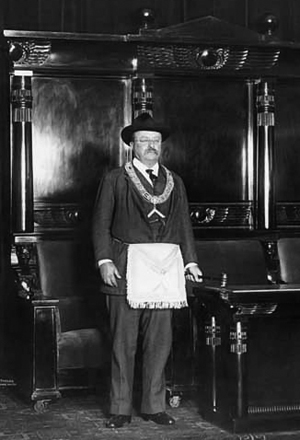
Roosevelt stands in a lodge room at Spokane wearing a white apron, an officer’s collar, and a hat, with a gavel in his hand. The Library of Congress catalogues the photograph by J. L. Phelps as circa 1912, after Roosevelt had left the presidency. The apron is clearly visible as part of his lodge dress.17
William Howard Taft: a formal portrait in regalia
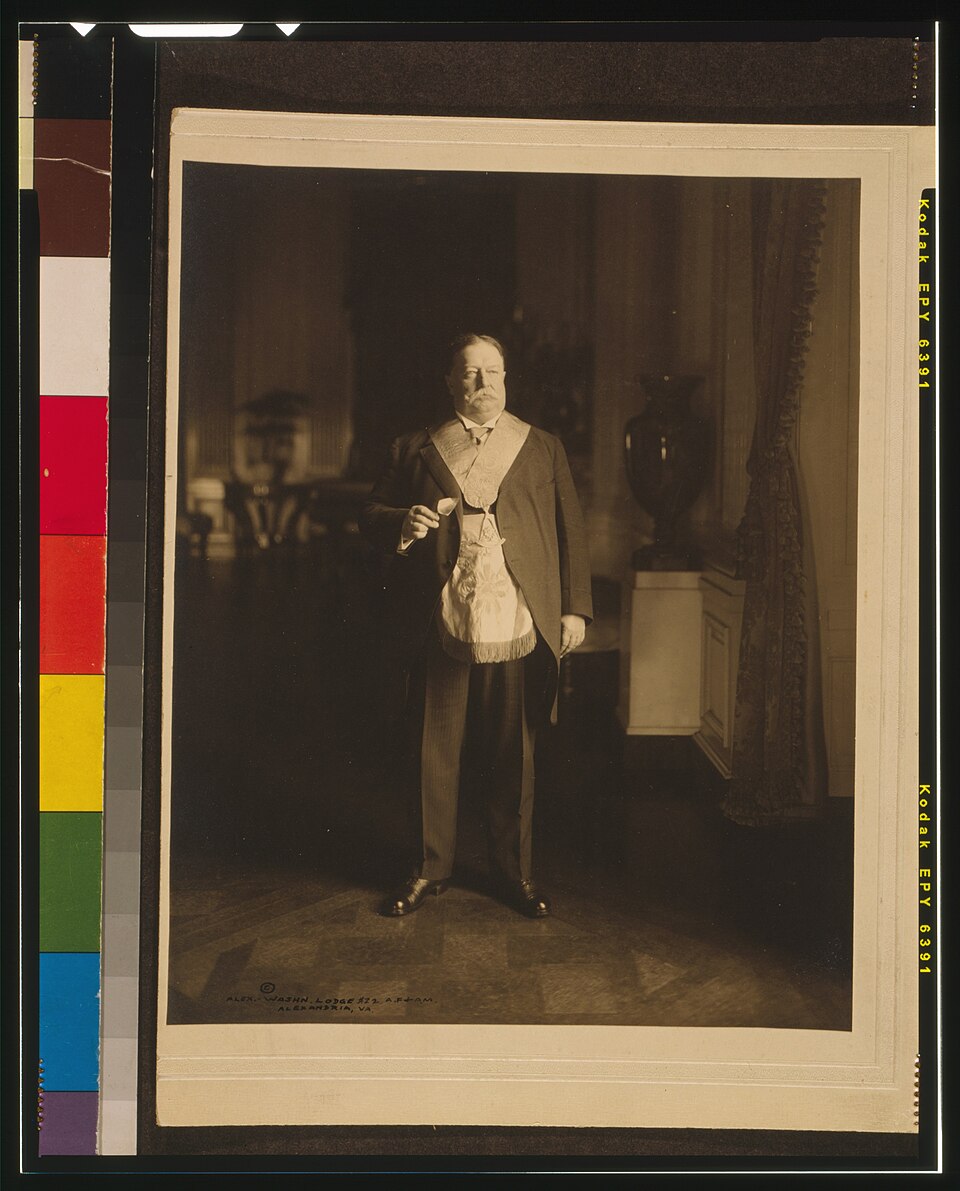
Jameson Studio in Alexandria photographed Taft wearing an embroidered apron and a broad ceremonial collar around 1911, during his presidency. Alexandria-Washington Lodge No. 22 registered the photograph for copyright. Its formal composition belongs to the same tradition of presidential Masonic portraiture that had made Washington’s image so familiar.18
Warren G. Harding: the Shrine fez
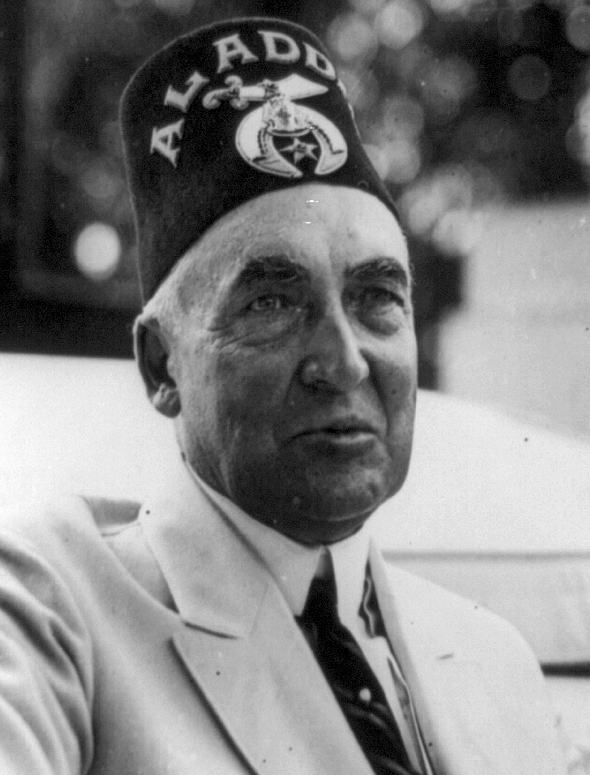
Harding’s photograph shows another part of the American Masonic world. He wears a Shrine fez while seated in a vehicle during his presidency. The fez identifies the Shrine tradition; it is distinct from the apron worn in a Craft lodge. Public Shrine events placed presidents among bands, delegations, parades, and spectators as well as in formal lodge ceremonies.19
Franklin D. Roosevelt: his sons’ lodge ceremony
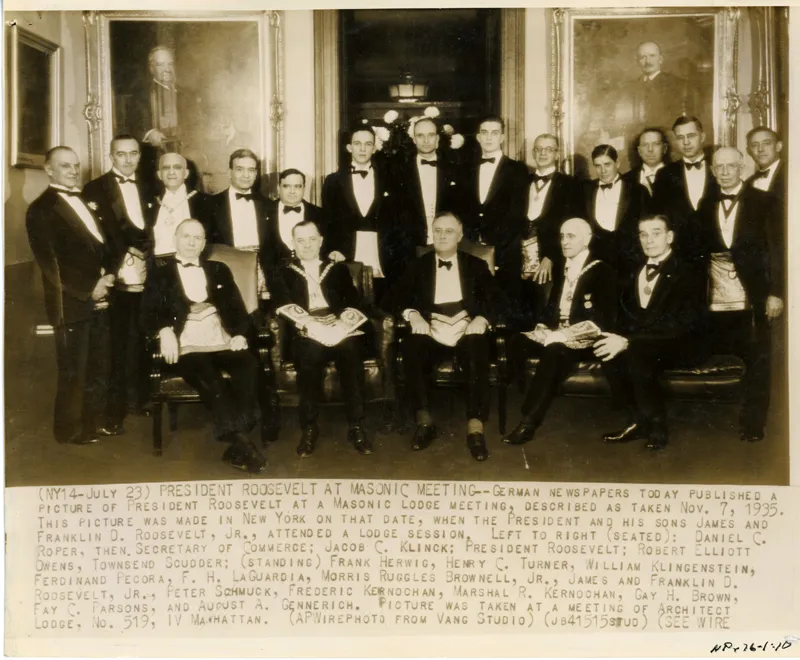
On 7 November 1935, Franklin Roosevelt participated in the raising of his sons James and Franklin Jr. at Architect Lodge No. 519 in Manhattan. In the group photograph, the president sits in the center with an apron across his lap. James and Franklin Jr. stand behind him. The event joined a family occasion with the lodge life Roosevelt had entered at Holland Lodge No. 8 in 1911.20
Harry S. Truman: an apron at the Washington memorial
Abbie Rowe photographed Truman with fellow dignitaries at the George Washington Masonic National Memorial on 22 February 1950. Truman, third from the left, wears an apron over his suit. The photograph records a sitting president’s public participation at a national Masonic memorial, more than a century and a half after Washington’s Capitol cornerstone ceremony.21

Women and the wider Masonic household
The exclusion of women from most American Craft lodges did not exclude them from the history of Masonic association. The Order of the Eastern Star developed from the work of Rob Morris in the middle of the nineteenth century; its General Grand Chapter was organized in 1876.15 Women held offices, administered funds, organized relief, and sustained local chapters. Eastern Star membership, however, did not confer the three Craft degrees on its women members.
Affiliated orders gave many women substantial administrative experience and public responsibilities. Their ceremonies drew on their own narratives and symbols. They were institutions with records, elections, disputes, and projects of their own, rather than a decorative appendix to a lodge history.

African American women built an especially extensive fraternal world. The Library of Congress identifies organizations including the Heroines of Jericho, Eastern Star chapters, Cyrenes, the Golden Circle, and Daughters of Isis. Their histories intersect with churches, schools, mutual aid, and the defense of community life under segregation. Their records are often less completely collected than those of male grand lodges, which makes surviving programs, photographs, and minute books particularly valuable.9
Some women sought participation in affiliated bodies; others sought initiation into Masonry itself. These were distinct paths. Women who sought initiation argued that equal ethical capacity should carry equal access to the lodge’s work.
The arrival of mixed Freemasonry
Mixed Freemasonry reached an organized American foothold at Charleroi, Pennsylvania, in 1903. Louis Goaziou, a French immigrant, former coal miner, and newspaper editor, had been corresponding with Antoine Muzzarelli. The resulting lodge, Alpha No. 301, brought together an immigrant working community and the international movement associated with Le Droit Humain.
The American Federation’s historical account records twelve men initiated on 18 October 1903, followed the next day by Marie Goaziou and Marie Barthelot. Alpha was constituted on 25 October. The first candidates and the work of the Charleroi community gave the international movement a local American foundation.10
Organization followed in stages. An American legal body was incorporated in Washington, D.C., in 1907. A federation meeting in 1908 elected Goaziou president, and an international charter followed in 1910. The lodge, the American legal association, and the international federation therefore took shape at different dates.11
Annie Besant’s international work helped spread co-Masonry through English-speaking networks, including circles associated with Theosophy. Those connections explain part of the movement’s circulation, but they do not make every mixed lodge Theosophical. Nor do all subsequent American mixed organizations share one governing authority. Changes of affiliation, independence, ritual practice, and admission policy have produced a varied institutional field.

The mixed tradition changed the question facing women. In an affiliated order, a woman could hold high responsibility without receiving the lodge’s Craft initiation. In a mixed lodge, women and men received the degrees and undertook the work as fellow members. American histories that end with the Eastern Star leave this development unexplained.
Hospitals, relief, and national cooperation
Relief began long before the construction of major charitable institutions. Local lodges paid funeral expenses, helped members through illness, and assisted widows and children. Grand lodges developed homes and other forms of organized care. These arrangements reflected the uneven availability of public welfare and commercial insurance, as well as a fraternal obligation toward members’ households.
The Shrine became one of the most visible organizations within the larger American Masonic world. Its early organizers began meeting in 1870; Mecca Temple in New York was established in 1872. The organization developed elaborate social ceremonies, uniforms, bands, and public parades. Its first children’s hospital opened in 1922. The hospital system became central to the Shrine’s public identity, although Shrine membership and hospital treatment are separate matters.12
Other Masonic bodies supported education, medical care, language and learning programs, and community relief. These projects differed in scale and eligibility. “Masonic charity” therefore names a range of institutions rather than one national fund. The source of a grant, the body administering a home, and the conditions attached to assistance are all part of its history.
National cooperation also developed without a national grand lodge. The Masonic Service Association, founded after the First World War, provided a means of coordinating service and information among participating jurisdictions. Conferences and memorial associations performed other shared functions. Their existence demonstrates cooperation across state boundaries while preserving the underlying independence of grand lodges.
Membership decline and the growth of mixed Masonry
The membership series published by the Masonic Service Association records a peak of 4,103,161 in 1959 and 869,429 in 2023. These figures concern the grand lodges covered by that series. They are not a census of all American Masonry and should not be presented as including every Prince Hall, women’s, mixed, liberal, or independent body.13
The decline affected the practical life of lodges: fewer candidates, aging membership, building costs spread among fewer dues-paying members, and mergers or closures. Changes in working hours, mobility, family arrangements, recreation, and patterns of voluntary association also altered the environment in which lodges recruited. No single explanation accounts for every community. A lodge that retained an active local role could have a different experience from a large urban temple struggling to support its property.
Growth in mixed Masonry
The contraction recorded by the older male grand lodges has not been the experience of every branch of American Masonry. Mixed bodies have reported membership gains and established new lodges during the broader period of decline. Their histories belong in the demographic account alongside those of the much larger male jurisdictions.
In an interview circulated in January 2014, Dianne Coombs, then a Mountain States District Deputy of Le Droit Humain’s American Federation, reported that the Federation’s membership had increased by nearly 50 percent over the preceding five years. She attributed the increase to greater visibility, personal relationships, and interest in the Order’s work. This was a reported gain for a particular mixed federation and period, rather than an estimate for every American mixed order.22
Local histories give the growth a more tangible scale. Amen-Ra Lodge in Wisconsin recalls a period when four members kept it operating, followed by recovery to an average membership of about twenty. In Arizona, members who had worked in study groups and triangles since 2009 received a charter for Radiance Lodge No. 2159; it was consecrated on 18 December 2022. These accounts describe both renewed membership in an older mixed lodge and the establishment of a new one.23, 24
The male grand lodge totals and these mixed-lodge reports measure different populations and time spans. They establish that mixed Masonry has experienced growth while the older male fraternity underwent a long contraction. They do not supply a single current national percentage by which all mixed orders can be compared with all male-only bodies.
Recognition and modern Masonic plurality
Recognition of Prince Hall jurisdictions by historically white grand lodges expanded during the late twentieth and early twenty-first centuries. Decisions were made jurisdiction by jurisdiction. Recognition did not mean merger, and continuing independence was not evidence that recognition had failed. Black Masonic institutions possessed their own histories, property, obligations, and reasons to preserve self-government.
Questions of race, religion, gender, and conscience still produce different rules among American bodies. The state grand lodge tradition, Prince Hall traditions, mixed and women’s obediences, and liberal organizations cannot be reduced to one national admissions policy. A reader considering membership should examine the particular body’s constitution and relationships.
DELPHI-USA belongs within that American plurality as part of an international mixed order with Greek origins. It does not claim authority over the older American grand lodges. Its presence continues a history in which American communities have received, adapted, and sometimes challenged Masonic institutions carried across national borders.
A chronology
| Period | Event |
|---|---|
| 1731–1734 | Franklin’s initiation, Pennsylvania leadership, and printing of Anderson’s Constitutions. |
| 1733 | Henry Price’s provincial organization in Boston. |
| 1752–1753 | Washington receives the three degrees at Fredericksburg. |
| 1775 | Prince Hall and fourteen others are initiated; African Lodge organizes. |
| 1784 / 1787 | African Lodge’s English charter is granted, then received in Boston. |
| 1793 | Washington participates in the Capitol cornerstone ceremony. |
| 1801 / 1813 | Southern and Northern Scottish Rite Supreme Councils established. |
| 1826–1832 | Morgan’s disappearance, Anti-Masonic organizing, and a presidential campaign. |
| 1861–1865 | Civil War military lodges operate on both sides. |
| 1872–1876 | Mecca Shrine Temple, Philadelphia’s new temple, and Eastern Star’s General Grand Chapter. |
| 1903–1910 | Alpha Lodge and the staged organization of American mixed Masonry. |
| 1922 | First Shriners children’s hospital opens. |
| 1959 onward | Membership peak in the Masonic Service Association series, followed by a long decline. |
Sources, documents, and further reading
Numbered references identify the records and institutional histories used for particular events. Image records and licenses appear beneath each illustration. Institutional histories are read as accounts of the bodies that publish them; their recognition claims do not settle the status of other traditions.
- Grand Lodge of Massachusetts: provincial foundation and institutional history
- Mount Vernon: Washington’s degree dates, lodge associations, and public ceremonies
- Library of Congress: Prince Hall Freemasonry research guide
- Scottish Rite Masonic Museum & Library: Prince Hall
- Scottish Rite Masonic Museum & Library: the Morgan affair and Anti-Masonry
- Scottish Rite Masonic Museum & Library: a Civil War military lodge
- Scottish Rite Northern Masonic Jurisdiction: historical chronology and institutional divisions
- Historic American Buildings Survey: Philadelphia Masonic Temple, historical data
- Library of Congress: African American women’s organizations and fraternal collections
- American Federation of Le Droit Humain: origins of American co-Masonry
- United States Court of Appeals, Tenth Circuit, 2002: institutional chronology in the Voirol litigation
- Shriners International: organizational and hospital history
- Masonic Service Association of North America: U.S. membership statistics
- Library of Congress: Join In—Voluntary Associations in America
- American Freemasons: introduction to the Order of the Eastern Star
- Scottish Rite Masonic Museum & Library: Franklin’s 1734 printing and the evidence identifying his press
- Library of Congress: Theodore Roosevelt, the master mason; photograph catalogued c. 1912
- Library of Congress: William Howard Taft in Masonic regalia, c. 1911
- Library of Congress: Warren G. Harding wearing a Shrine fez, 1921–1923
- Franklin D. Roosevelt Presidential Library: FDR’s Masonic record and the November 1935 ceremony
- National Archives photograph, NAID 200176: Truman in Masonic regalia, 22 February 1950; NARA metadata reproduced on Commons
- Greg Stewart’s interview with Dianne Coombs, circulated 31 January 2014: reported American Federation growth during the preceding five years
- Le Droit Humain, American Federation: Amen-Ra Lodge history and membership recovery
- Le Droit Humain, American Federation: Radiance Lodge charter and consecration, 18 December 2022