Masonic symbols are a language of reflection. Tools associated with building—among them the square, compasses, level, plumb, gavel, and chisel—invite members to examine how they think, act, and live with others. Their value lies in the questions they open: What makes conduct upright? How should freedom be measured against responsibility? What can a person change through patient work?
There is no single international dictionary that settles every meaning. Symbols acquire different emphases across rites, degrees, jurisdictions, and historical periods. The examples below introduce public interpretations without treating one tradition as the rule for all Freemasonry.
The square tests a right angle; in Masonic reflection, it commonly suggests rectitude, honesty, and fairness. The question is practical: do our actions meet the standards we claim to hold? A square cannot make a stone sound by appearance alone. In the same way, reputation cannot substitute for conduct.
The compasses draw a circle and establish a distance. They encourage reflection on measure, discernment, and the limits we place on our own impulses. Together, the two instruments bring precision into conversation with imagination. Historical readings have also associated the square with the material world and the compasses with spiritual aspiration. Those readings belong to particular contexts, rather than imposing one religious interpretation on every member.
The familiar emblem itself varies. A letter G appears in some versions and is absent in others. An emblem should therefore be understood alongside the body that uses it, rather than assumed to describe every Masonic institution.
A rough ashlar and a carefully worked stone give visible form to the idea of personal development. The contrast invites a person to recognize habits, prejudices, and shortcomings, then undertake the slow work of improvement. It does not make one human being more valuable than another.
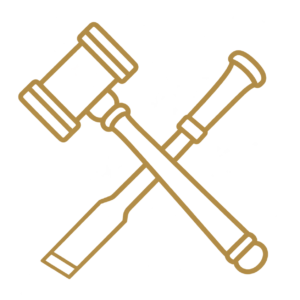
The gavel and chisel make that work concrete. A blow without judgment can damage the stone; a finely chosen intention without effort leaves it untouched. As a moral image, their cooperation joins determination to thought. Progress requires both the willingness to act and the humility to reconsider how one acts.
Read this way, the tools do not promise perfection. They offer a method: observe, reflect, make a correction, and return to the work.
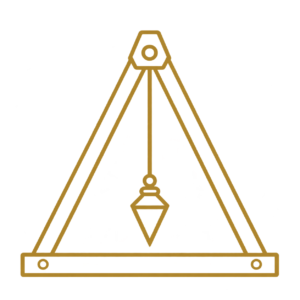
The level commonly recalls equality, while the plumb line suggests uprightness. Their relationship is useful: equal regard for others must be accompanied by an honest examination of oneself. Equality is not sameness, and uprightness is not a license to judge everyone else.
The trowel, which spreads the material joining stones, can represent cohesion and fellowship. A community is strengthened by the quality of its connections: listening, mutual assistance, reliable commitments, and disagreement conducted with respect. These are ordinary responsibilities, made memorable through the language of the craft.
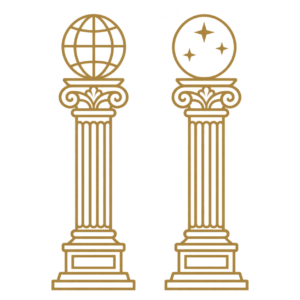
Pillars and temple imagery place individual work within a larger architectural setting. The biblical account of Solomon’s Temple, including its two named pillars, became an important reference in Masonic traditions. It offers a vocabulary for considering stability, proportion, and the construction of a shared moral life.
A symbolic reference is not, by itself, evidence of an uninterrupted institutional descent from antiquity. Historical inquiry and symbolic interpretation ask different questions. Keeping both in view allows the imagery to be studied seriously without turning a meaningful narrative into an unsupported claim about origins.
Light often gives form to the pursuit of understanding. It can suggest learning, an awakened conscience, or the effort to see beyond a first impression. The luminous triangle, sometimes containing an eye, also has a history in religious art outside Freemasonry.
Its meaning depends on setting. In some traditions it expresses divine presence; in others, attention falls on conscience or spiritual awareness. Recognizing that variety is more useful than presenting the eye as a secret emblem with one universal explanation. A symbol shared across artistic and religious histories cannot be understood through conspiracy alone.
A tracing board gathers several symbols into a visual composition. It can act as a teaching aid and a focus for discussion, allowing objects and relationships to be considered together. The arrangement is significant, but its interpretation depends on the rite, degree, and period to which it belongs.
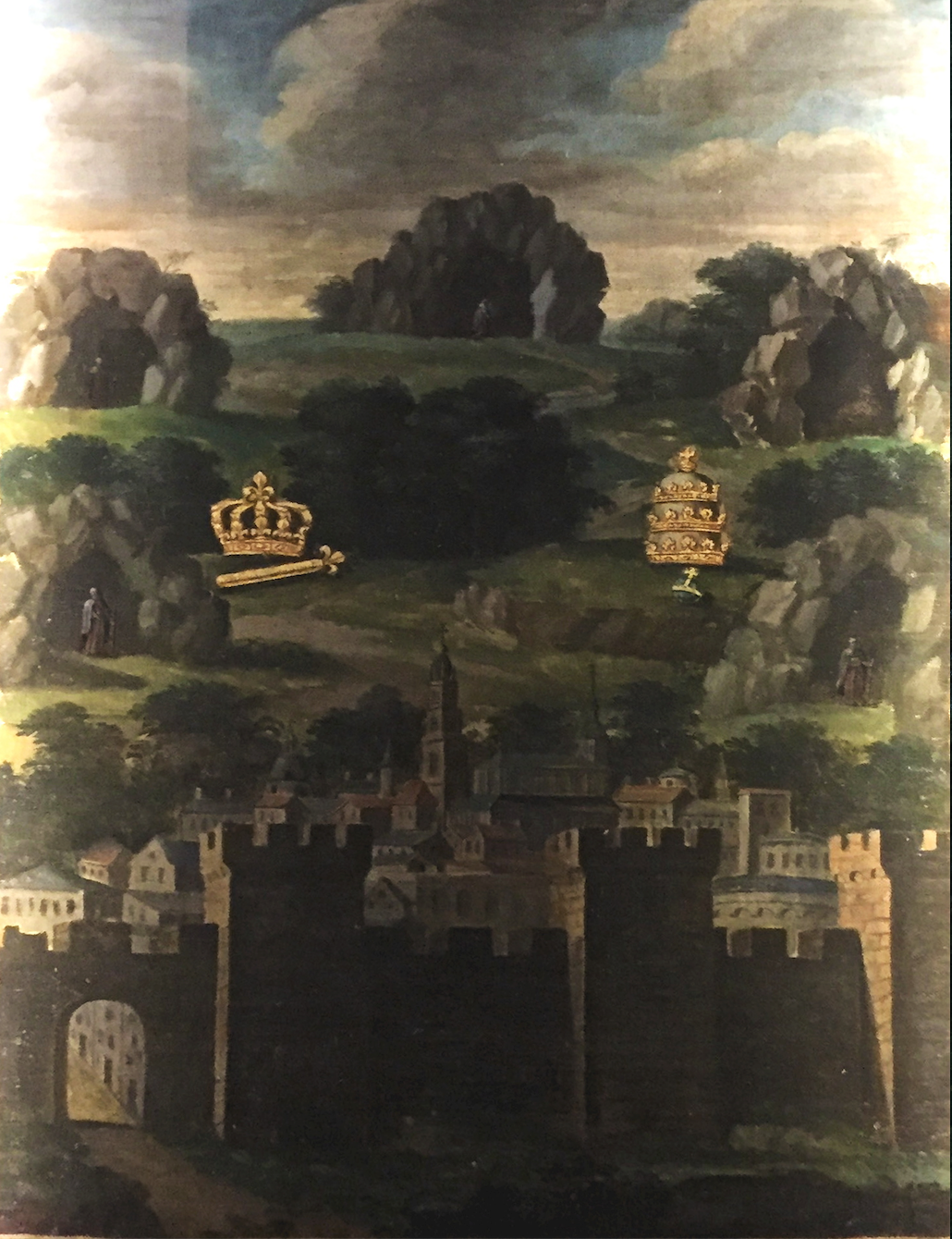
The historical board shown here belongs to a higher-degree setting. It illustrates the richness of Masonic visual culture; it should not be taken as a universal diagram of the three Craft degrees or as a depiction of DELPHI-USA practice. Identifying an object’s context is the first step toward reading it responsibly.
Masonic imagery also appears in carved wood, textiles, prints, jewelry, and domestic objects. These works preserve evidence of individual makers and the communities around them. They deserve attention as art and material history as well as symbols.
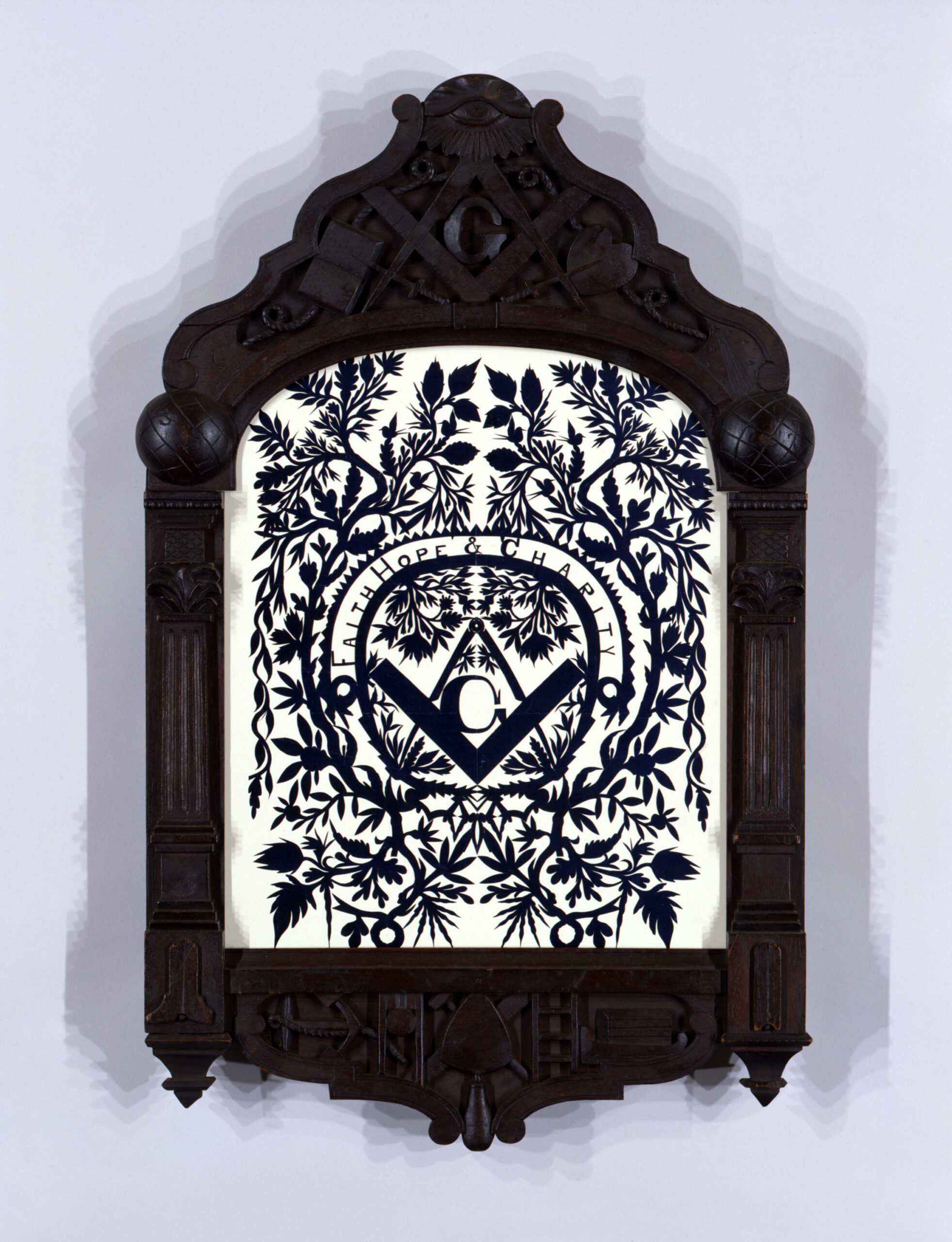
John Haley Bellamy’s nineteenth-century carved frame is one example. Bringing Masonic motifs into a crafted object makes visible the connection between an idea and the hand that gives it form. Studying the maker, material, date, and collection can reveal more than assigning an isolated meaning to each detail.
These illustrations give visible form to several of the ideas discussed here. They are visual aids; designs and interpretations vary between Masonic traditions.
Symbols become worthwhile when reflection changes behavior. A member may contemplate integrity through the square, equality through the level, or fellowship through the trowel; the test follows in daily life. Does that reflection produce greater fairness, care, and responsibility?
For readers exploring mixed Freemasonry, this is a useful starting point: men and women can approach a shared symbolic language as equal participants in inquiry. The aim is thoughtful work, with room for different experiences and considered interpretations.
Continue with our introduction to mixed Freemasonry, our account of Masonic methodology, and our guide to the three degrees. The companion article on Masonic regalia considers how this language is carried in aprons, collars, and jewels.