Freemasonry’s relationship with the Enlightenment is best understood through the institutions, people, and habits of exchange that connected them. In eighteenth-century lodges, members met regularly, practiced ceremonies, discussed ideas, and built relationships across parts of a changing society. Some of these settings encouraged inquiry, religious toleration, and a language of moral equality.
The history is plural. A lodge could bring a scientist, an artist, and a diplomat into conversation without giving them identical convictions. Its significance lies partly in that encounter: people learned to associate through shared forms while retaining differences of experience and opinion.
The Musée de la franc-maçonnerie draws attention to links between figures in the early London Grand Lodge and the Royal Society. Jean-Théophile Désaguliers, a French-born Huguenot and an important Masonic organizer, belonged to the Newtonian intellectual world. The study of nature and the possibility of religious toleration formed part of that setting.
The Constitutions published in 1723, associated with James Anderson, helped give the developing fraternity a written framework. Their treatment of religion sought common moral ground while allowing members to retain their particular opinions. That was an important response to religious division, though it belonged to the assumptions and limits of its own period.
A modern reader can appreciate this experiment while asking exactly who was included, on what terms, and in which place. Those questions make tolerance a subject for historical inquiry as well as an inherited ideal.
Freemasonry became established in France during the 1720s and expanded through networks of lodges. The French museum’s account describes convivial settings in which members celebrated virtue and equality. Meetings, shared meals, and discussion gave those words a social form.
This helps explain the importance of sociability: the practice of meeting and relating to others. An idea can circulate in a book, but it is tested differently when people must take turns speaking, listen, and maintain a relationship through disagreement. The lodge offered one setting in which such habits could develop.
It also existed within the surrounding social order. Aristocratic patrons, professional connections, and local circumstances shaped particular lodges. Historical fellowship should be studied through those circumstances rather than imagined as a complete escape from the world outside.
The Paris lodge Les Neuf Sœurs, the Nine Sisters, offers a particularly clear example. Its name referred to the nine Muses of the arts and sciences. The Scottish Rite Masonic Museum & Library preserves an eighteenth-century membership list and identifies a circle that included Benjamin Franklin, the astronomer Jérôme de Lalande, the sculptor Jean-Antoine Houdon, and Voltaire.
Franklin served as the lodge’s Vénérable, or presiding Master, from 1779 to 1781. His participation coincided with his diplomatic work in France during the American Revolution. The lodge was one among several circles through which he met people and cultivated relationships.
The surviving membership record is more valuable than an impressive list of names alone. It locates association in a particular place and time. It gives historians evidence with which to examine how intellectual, artistic, and international lives intersected.
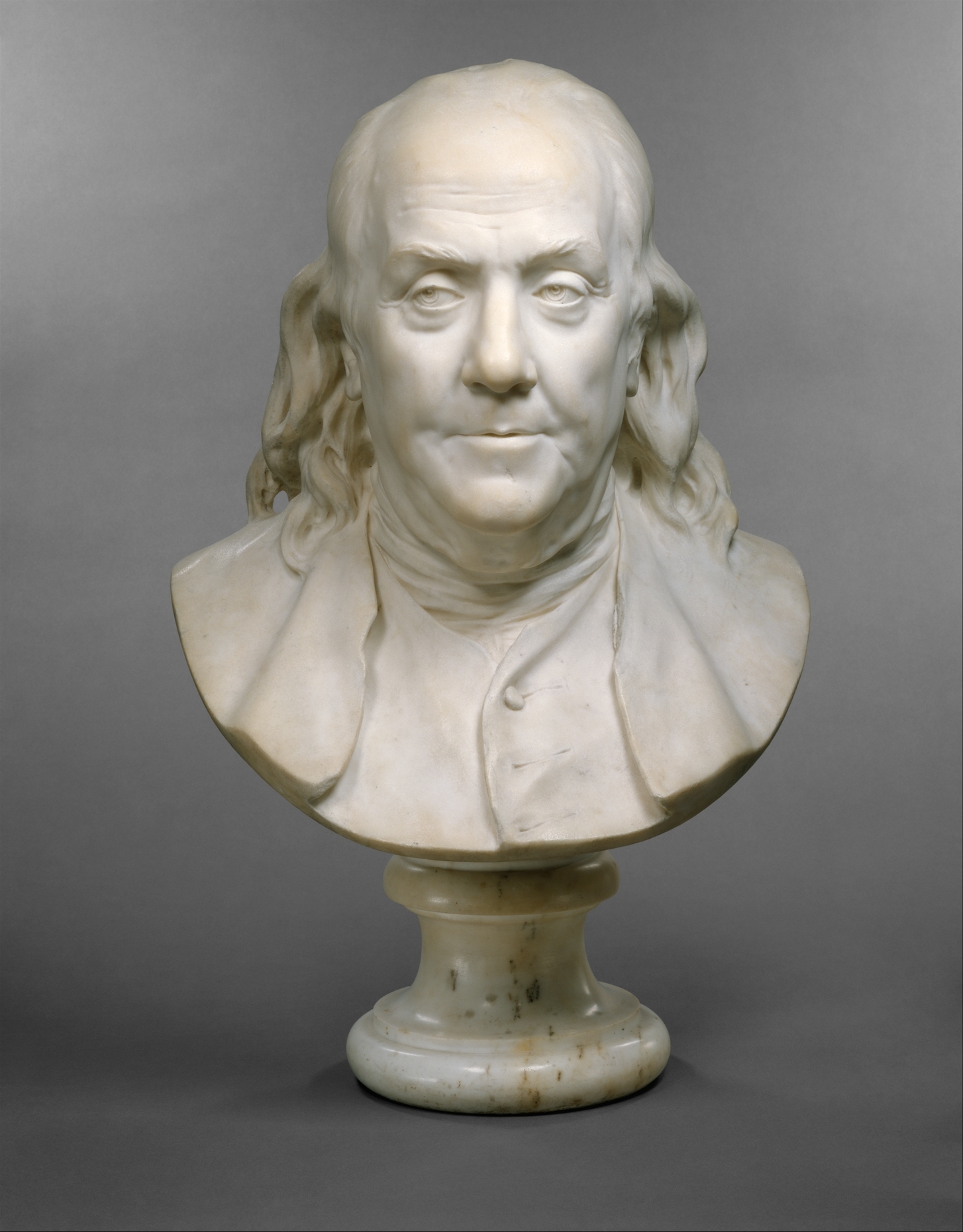
Houdon’s 1778 marble portrait of Franklin, now at The Metropolitan Museum of Art, makes one of those connections visible. The museum describes the public fascination with Franklin in France and the circulation of his image through the work of contemporary artists.
The Met also notes the shared membership of Houdon and Franklin in the Nine Sisters. Whether Franklin formally sat for this portrait has been debated; the sculptor nevertheless had opportunities to observe him within their overlapping circles.
The bust is therefore both an artwork and a point of entry into a social world. Looking at the maker, sitter, collection record, and documented associations allows the object to support a richer account than symbolism alone could provide.
The relationship between Freemasonry and the French Revolution illustrates the limits of sweeping explanations. Masons participated in revolutionary events, but their responses ranged from enthusiasm to opposition. The Musée de la franc-maçonnerie records that the duc de Montmorency-Luxembourg, an important figure in the Grand Orient de France, emigrated after the fall of the Bastille.
Lodges also faced suppression during the Terror. These different experiences resist the idea of Freemasonry acting as one coordinated political force. Membership in a common association does not establish common responsibility for every member’s decisions.
When studying political influence, it is useful to distinguish personal action, networks of acquaintance, the decisions of a particular lodge, and the policy of a Masonic institution. Each requires its own evidence.
The language of equality raised questions that later generations would press further. The emergence of organized mixed Freemasonry in the nineteenth century is one chapter in that continuing examination of participation. Ideals acquire practical meaning through the people admitted to share responsibilities and shape an institution’s life.
For Masons today, the Enlightenment offers an inheritance to study and develop: curiosity, careful judgment, freedom of conscience, and the willingness to meet another person as a thinking equal. Those commitments are sustained through conduct, including the ability to revise an explanation when the evidence requires it.
Read more about freedom of conscience, the Masonic schism of 1877, and mixed Freemasonry.