Prince Hall’s place in Masonic history cannot be separated from the struggle of Black Americans to organize, educate their children, and claim freedom. His story also asks a difficult question of any institution that speaks of universal brotherhood: what happens when the people who affirm an ideal do not extend it equally?
The Library of Congress dates the initiation of Hall and fourteen other free Black men to 6 March 1775. It records the organization of African Lodge No. 1 that July and the granting of an English charter in 1784, after which the lodge became African Lodge No. 459.
These records matter because they anchor the history in an identifiable community and an institutional development. Prince Hall Freemasonry should be encountered through the organizations and people who built it, rather than reduced to an illustrative name in somebody else’s history.
A 1787 petition by the African Lodge to the Massachusetts legislature makes the situation of its members explicit. The document describes the violence through which Africans and their descendants had been enslaved, acknowledges changes in their legal circumstances, and explains why serious disadvantages remained.
The petition sought assistance for a return to Africa. Its argument should be read in the setting of the people making it, rather than forced into a later narrative of inevitable progress. It records choices being considered by people whose freedom remained insecure and whose equality was not assured.
The National Park Service’s account of Prince Hall’s son Primus places the family within Boston’s wider Black civic life. It records father and son signing an antislavery petition in 1788 and describes Primus’s later work for the education of Black children.
This broader setting is important. Lodges existed alongside households, businesses, churches, petitions, and schools. To understand a member’s public life, a researcher needs to examine those relationships rather than assume that a Masonic affiliation alone explains every action.
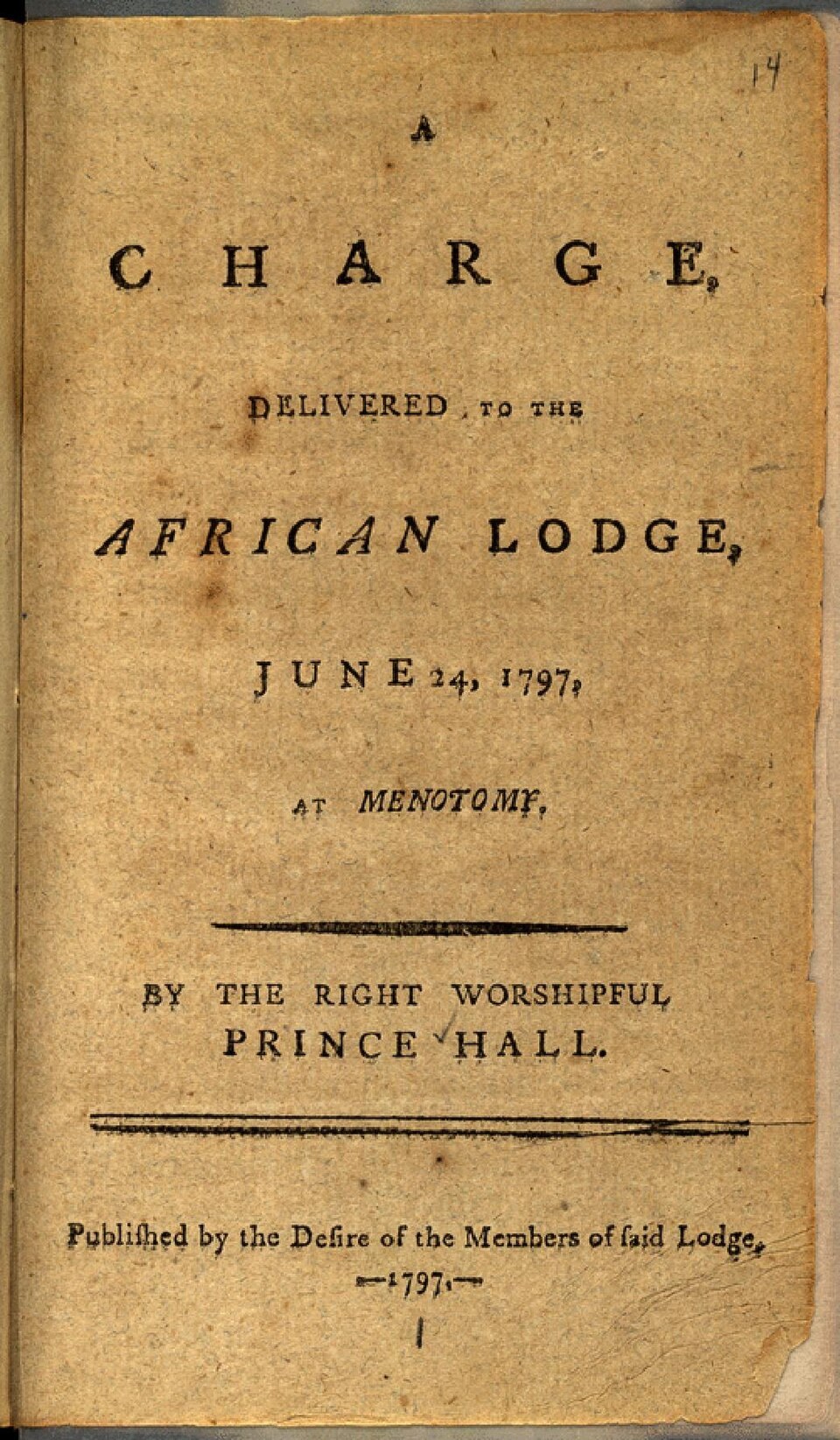
Hall’s A Charge Delivered to the African Lodge, dated 24 June 1797, survives in the Library of Congress. The title page reproduced here is evidence of a particular published address, with an author, audience, place, and date. It offers a better point of departure than a circulating quotation without a traceable source.
Printed texts also require interpretation. A speech delivered to a lodge has a purpose and audience; it is not automatically a neutral description of all contemporary Masonic life. Reading it carefully means attending both to what is said and to the circumstances in which it was said.
Prince Hall Freemasonry is not simply another name for liberal or mixed Freemasonry. It has its own institutional histories. The evidence presented here does not make Hall a member of a modern liberal organization or establish that his lodge practiced mixed membership.
His history belongs in this collection because claims about fraternity and equality should be examined alongside the experiences of those who encountered exclusion. A comparison can illuminate a shared ethical question without erasing distinct traditions.
The DELPHI reference text understands equality as independent of race, origin, gender, social class, or wealth. It joins this to fraternity, charitable effort, and a duty to oppose injustice. Hall’s history gives us a concrete setting in which to reflect on those responsibilities, without claiming his distinct tradition as our own.
Fraternal care must also remain honest. The same text rejects professional favoritism and the concealment of wrongdoing for a fellow Mason. A commitment to universal dignity asks us to serve the wider community, including those who have no connection to a lodge.
In our reading, the lesson is not that an institution becomes equal by announcing equality. We should ask who can enter, who can lead, whose testimony is preserved, and who must build an independent institution to exercise rights others already take for granted.
These questions are equally valuable when studying women’s Masonic history or the different forms of inclusion that exist today. They permit admiration for a principle while keeping its historical limits visible.
Continue with women’s routes to Masonic autonomy and the responsibilities of a lodge toward its community.
Reviewed against DELPHI’s reference PDF on 25 November 2026. Sources describing other bodies support the comparative history; their policies are not presented as DELPHI’s own.