
Laïcité is a French term commonly associated with secular public institutions and liberty of conscience. In liberal Masonic discussion, it concerns the conditions under which people with different beliefs can inhabit a shared civic world. It should not be translated simply as a requirement that individuals become atheists.
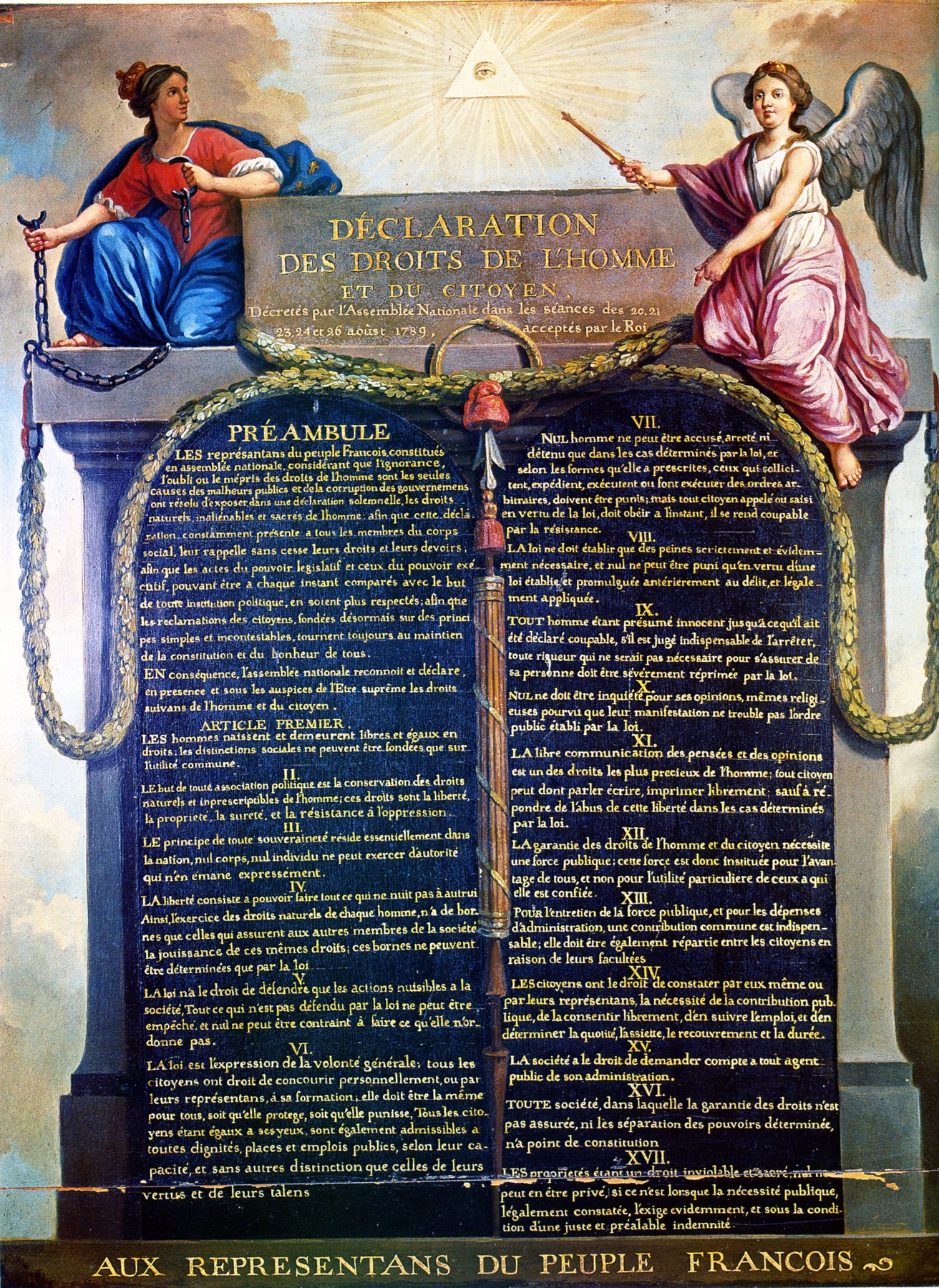
The illustration is a civic declaration from 1789, not a Masonic constitution. It places the discussion within the history of rights; its imagery is not evidence of Masonic authorship.
What may a person believe? How should a public institution treat people who believe differently? The first concerns individual conscience. The second concerns the terms of common life. Confusing them makes secularism appear to require a uniform private worldview.
A useful starting point is the difference between protecting a person’s liberty and giving a religious or philosophical body authority over everyone. It is possible to defend the former while questioning the latter. That is a conceptual distinction, not a complete description of any country’s laws.
Article 1 of France’s law of 9 December 1905 affirms freedom of conscience and the free exercise of religion, subject to the law’s public-order provisions. Both parts matter. The historical reference is more precise than a general claim that secularism means removing belief from human life.
The 1789 Declaration of the Rights of Man and of the Citizen belongs to an earlier moment in the history of rights. It should not be confused with the 1905 settlement, or treated as proof that the later legal and political questions had already been resolved.
The Grand Orient of France gives laïcité a central place in its public values, connecting it to a common civic space in which individuals may live according to their philosophical or spiritual convictions. It also places solidarity and human dignity among its stated commitments.
The Grande Loge Mixte de France approaches the subject through language, history, and public texts. Its explanation emphasizes the ability of individuals with different origins and convictions to develop freely. These accounts show how secularism can be discussed as a condition of coexistence rather than as a catalogue of people to exclude.
The Gran Oriente de la Franc-Masonería del Uruguay uses the related term laicidad. Its public account links the plurality of private beliefs and cultures to the construction of a free and equal common society. The vocabulary travels, but the national history and institutional setting still matter.
For an English-speaking reader, there is no need to assume that French laïcité, Uruguayan laicidad, and American discussions of religious liberty are identical arrangements. Comparison becomes more useful when the similarities and differences are named.
Respect for a person does not require agreement with every proposition that person holds. Equally, disagreement with a belief does not justify humiliating its holder. A community committed to inquiry needs room to distinguish the dignity of the participant from the question being examined.
That distinction provides a practical discipline for discussion: state the claim clearly, ask what supports it, hear the response, and avoid treating membership of a religious or nonreligious group as an answer in itself. These are suggested habits for reflection, not a claim that every lodge conducts debate identically.
Our reference text connects freedom of conscience with noninterference in another person’s metaphysical and religious beliefs. It also describes Freemasonry as concerned with moral and spiritual values. Respect for secular civic institutions does not require the abandonment of that inward inquiry, nor hostility toward a member’s religion.
The text supports democratic life, human rights, and opposition to injustice while making clear that Freemasonry is not a political organization. Serious discussion of society can take place in a spirit of fraternity and without fanaticism; party allegiance and political division must not become conditions of fellowship. The national positions of the bodies cited above provide context, rather than a ready-made political programme for DELPHI.
What would make a common space genuinely open to people whose convictions differ? The answer requires attention to participation, language, access, and the way authority is exercised. An abstract declaration of tolerance is a beginning; the experience of those taking part tests how it is understood.
Read further on freedom of conscience and Masonic responsibilities toward the wider community.
Reviewed against DELPHI’s reference PDF on 25 November 2026. Sources describing other bodies support the comparative history; their policies are not presented as DELPHI’s own.