Anti-Freemasonry is opposition to Freemasonry as an institution, or hostility toward people because they are Freemasons. Its history reaches across Europe, the Americas, and the Middle East. Religious authorities have challenged Masonic membership; political movements have campaigned against lodges; authoritarian governments have confiscated property, exposed membership lists, and imprisoned members. These experiences were different in cause and severity. Studying them together helps explain how private association can become a target of public suspicion—and why freedom of conscience and the right to assemble deserve lasting protection.
The Greek lodge network grew in the nineteenth century alongside contacts with Continental Freemasonry. The Grand Lodge of Greece traces an early connection to the Grand Orient of France through Dionysios Romas’s 1811 petition for recognition of a Corfu-based body. It also records that an Athens lodge founded in 1863 under the auspices of the Grand Orient of Italy was followed by lodges elsewhere, including Archimedes in Patras. A Grand Orient of Greece was established in 1868, following Italian recognition of Greek Masonic independence the previous year.
Patras also appears in accounts of late nineteenth-century anti-Masonic agitation associated with the Orthodox lay preacher Apostolos Makrakis. The surviving sources used here establish the lodge’s place in Greek Masonic history more clearly than they establish the dates or particulars of the local confrontation. The Church of Greece’s later formal statement is much better documented.
On 12 October 1933, the hierarchy of the Church of Greece met to consider Freemasonry. Its official bulletin recorded a decision adopted unanimously by the bishops after they heard a commission report and considered theological opinions. The hierarchy interpreted Masonic initiation and symbolism through an Orthodox theological lens, viewed Freemasonry as religious in character, and judged membership incompatible with Orthodox Christian allegiance. The bulletin records an ecclesiastical decision about religious affiliation. It supplies evidence of the Church’s position at that time.
A separate interruption came during the Axis occupation. The Grand Lodge of Greece records that it had to leave its premises and cease operations during the war. Athens was liberated in October 1944, and the Grand Lodge dates its first postwar Grand Council meeting to 3 March 1945, when it planned the resumption of lodge work. Those are distinct dates for the liberation of the city and the restoration of the institution’s operations.
In September 1826, William Morgan disappeared after being taken from Canandaigua, New York. He had been preparing a book disclosing Masonic rituals. Investigators and later historians traced his removal from the jail area toward Fort Niagara. The case produced multiple investigations and trials, but Morgan’s ultimate fate was never established. The disappearance gave existing suspicions about private oaths and personal influence a concrete, widely reported case.
Opposition in western New York broadened into a political movement in the late 1820s. In his history of the Anti-Masonic Party, William Preston Vaughn describes the role of religious activists and the way a local outcry became organized electoral opposition. Anti-Masons questioned whether ties among lodge members could influence justice and public office. Concerns about the conduct of identifiable individuals could be investigated through testimony and court records. Claims of coordinated influence across the fraternity require evidence of a different scale.
The movement reached the presidential ballot in 1832. Its ticket, William Wirt and Amos Ellmaker, carried Vermont’s seven electoral votes. Andrew Jackson won the election with 219 electoral votes. The party declined after that election, but the episode shows how a particular criminal case could turn into a broader debate over public accountability and private associations.
Brazil’s Questão Religiosa, or Religious Question, brought Freemasonry into a major conflict over church and state in the 1870s. In 1872, the priest and Mason Almeida Martins was suspended after speaking at a Masonic gathering. Bishops in Pernambuco and Pará subsequently acted against Catholic brotherhoods that included Freemasons. Their measures challenged an imperial system in which important ecclesiastical decisions depended on government approval.
The dispute escalated into legal proceedings against the bishops, imprisonment, and an amnesty in 1875. It was therefore more complicated than a confrontation between an all-powerful church and a powerless fraternity: Masons also held important positions within the imperial establishment. The episode illustrates how religious exclusion, constitutional authority, and political influence could become entangled. It should be understood within that Brazilian setting rather than treated as another version of European fascist persecution.
In Italy, Fascist intimidation and attacks on lodges preceded the destruction of their public institutional life. The Grande Oriente d’Italia records that Grand Master Domizio Torrigiani ordered its lodges to cease work on 22 November 1925 after months of violence and mounting legislative pressure. The association law of 26 November tightened the regime’s control and barred public officials from Masonic membership.
Torrigiani himself was arrested in 1927 and sentenced to five years of police confinement, first on Lipari and later on Ponza. His experience shows what suppression meant beyond the closure of a meeting room: personal liberty, livelihood, and the ability to maintain a community could all be placed at the state’s disposal.
After the Nazis took power in 1933, pressure on German lodges escalated through coerced closures, exclusion from professional and public life, police seizures, and official dissolution. The United States Holocaust Memorial Museum records that on 17 August 1935, Interior Minister Wilhelm Frick ordered the remaining lodges and their branches dissolved and their assets confiscated. Nazi propaganda also folded anti-Masonry into antisemitic conspiracy narratives. The sources document persecution and institutional destruction, though outcomes varied for individual Freemasons.
In Belgrade, the Grand Anti-Masonic Exhibition opened in October 1941 under German occupation. German funding and collaborationist support turned an exhibition into an instrument of antisemitic and anti-Masonic agitation. The poster reproduced below depicts caricatures of Joseph Stalin and Winston Churchill as puppets controlled by an antisemitic caricature of a Jewish figure. Stalin represents communism, while Churchill is shown wearing a Masonic apron and collar incorporating a Star of David. The central figure also wears a Masonic-style collar combined with Jewish symbols. These deliberately conflated emblems belong to the propagandist’s imagery, not to an accurate account of Jewish identity or Masonic regalia. It collapses distinct communities and political positions into an imaginary hidden command structure.
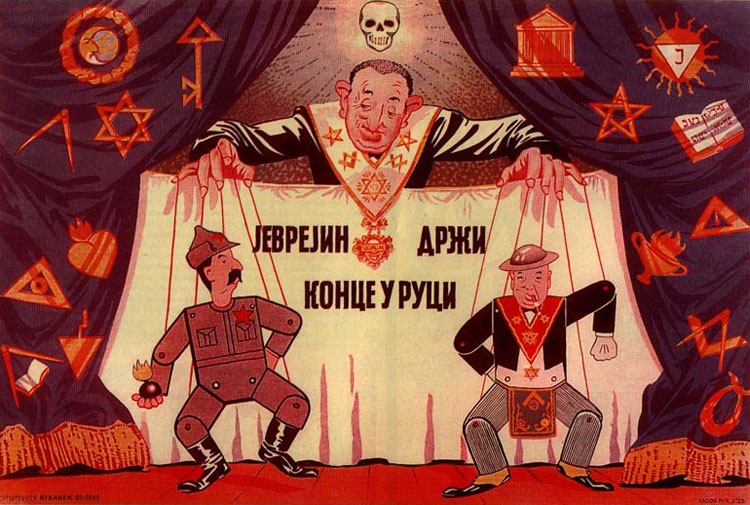
This was propaganda designed to make persecution appear justified. Masonic symbols and Jewish imagery were assembled to suggest guilt by association, not to present evidence of a real conspiracy. The exhibition must also be understood within the wider Nazi persecution and murder of European Jews; the histories of antisemitism and anti-Masonry intersect, but they are not interchangeable.
Belgrade was part of a wider campaign. The United States Holocaust Memorial Museum documents anti-Masonic exhibitions in occupied Paris in October 1940 and Brussels in February 1941. Stolen lodge objects, membership records, and buildings were repurposed to help authorities display the supposed enemy they had already decided to suppress. The Liberal Grand Lodge of Serbia also records arrests, seized archives, and the interruption of lodge work during the occupation.
Vichy enacted legislation against so-called secret societies on 14 August 1940. The repression reached lodge records and objects as well as the organizations themselves. Authorities centralized seized archives, while anti-Masonic exhibitions displayed selected material to support the regime’s portrayal of lodges. The Grand Orient de France records that its museum, founded in 1889, was plundered during the Occupation. It reopened in 1973 and gradually rebuilt its collections.
A lodge register and a police dossier drawn from it are two different types of record. The register can help reconstruct lodge activity. The dossier can show how authorities classified people and used their names for surveillance. Researchers working with the Grand Orient’s archives have examined how confiscation and later recovery shaped what survives.
Spain’s law of 1 March 1940 explicitly made belonging to Freemasonry, communism, and specified clandestine organizations a crime. The law’s preamble blamed Freemasonry for a wide range of national events and grievances. Read alongside the operative articles, it shows how the regime combined sweeping accusations with penalties for association. The text was published in Spain’s official gazette on 2 March.
Portugal’s Estado Novo adopted Law No. 1901 on 21 May 1935 against secret associations. The legal record matters alongside the rhetoric: it shows how a government could turn suspicion into an administrative framework for dismantling independent organizations. A subsequent parliamentary file from 1936–1937 concerns the transfer to the Portuguese Legion of property belonging to the Grémio Lusitano, already listed under that law.
Such records make the material consequences of repression visible. A lodge could lose not only the freedom to meet, but also the rooms, books, and resources through which its shared life had been sustained.
Suppression did not begin with the twentieth-century dictatorships. In 1822, Alexander I ordered the closure of secret societies, explicitly including Masonic lodges. Nicholas I reaffirmed the prohibition in 1826. The Saint Petersburg Encyclopaedia places these decisions after a period in which lodges had attracted writers, officials, military officers, and other participants in Russian intellectual life.
The change from toleration to prohibition is instructive. An association could be accepted under one political climate and treated as a danger under another. Membership, personal acquaintance, and private meetings could become subjects of official inquiry. These imperial restrictions arose in a different setting from later racial propaganda, but they similarly placed independent networks under the scrutiny of the state.
Anti-Masonic persecution also reached beyond Europe and the Americas. Historian Ahmad Ashraf, writing in Encyclopaedia Iranica, describes how Freemasons became targets during Iran’s 1978–1979 revolutionary upheaval. Different participants in the revolutionary coalition associated the fraternity with foreign influence and the fallen political order. The seizure and disclosure of lodge archives and membership rosters made individual members identifiable.
Ashraf records that membership was criminalized and that Freemasons faced execution, imprisonment, dismissal from public employment and universities, confiscation of property, and restrictions on leaving the country. The history of Iranian Freemasonry also continued in exile. The lesson is concrete: a list created to administer an association can become a means of persecution when authorities treat membership itself as proof of wrongdoing.
A theological declaration, a criminal trial, a propaganda poster, and a confiscation order answer different historical questions. The Greek church bulletin records an ecclesiastical judgment; the Morgan investigations concern a particular disappearance; the Belgrade poster reveals the methods of propaganda; and laws and seized archives document the powers of repressive states. None should be made to say more than the evidence supports.
Freemasons have not all held the same beliefs or political commitments. Nor does a famous member’s public role prove that a lodge directed that person’s actions. Responsible history allows criticism of identifiable conduct while rejecting accusations of collective guilt. It also recognizes suffering without inventing a single global explanation for every conflict.
Lodges have been closed, libraries scattered, and members driven into silence or exile. Yet the work has been renewed. In Greece, lodge life resumed after liberation. In Serbia, Masonic institutions re-emerged after decades of interruption. Iranian Masons carried parts of their tradition abroad. Survival has depended on people preserving relationships, remembering those who were lost, and rebuilding spaces for reflection and fellowship.
For DELPHI-USA, remembrance is a responsibility. We remain committed to liberty, equality, fraternity, and freedom of conscience. Men and women meet as equals to pursue moral and personal development, to examine their own assumptions, and to practice care for others. The answer to a history of exclusion is to make those commitments visible in the way we live.
We do not inherit an exemption from scrutiny. We inherit a duty to act with honesty and integrity, to welcome sincere questions, and to oppose the dehumanization of any community. Despite this history, we remain—and the work continues.